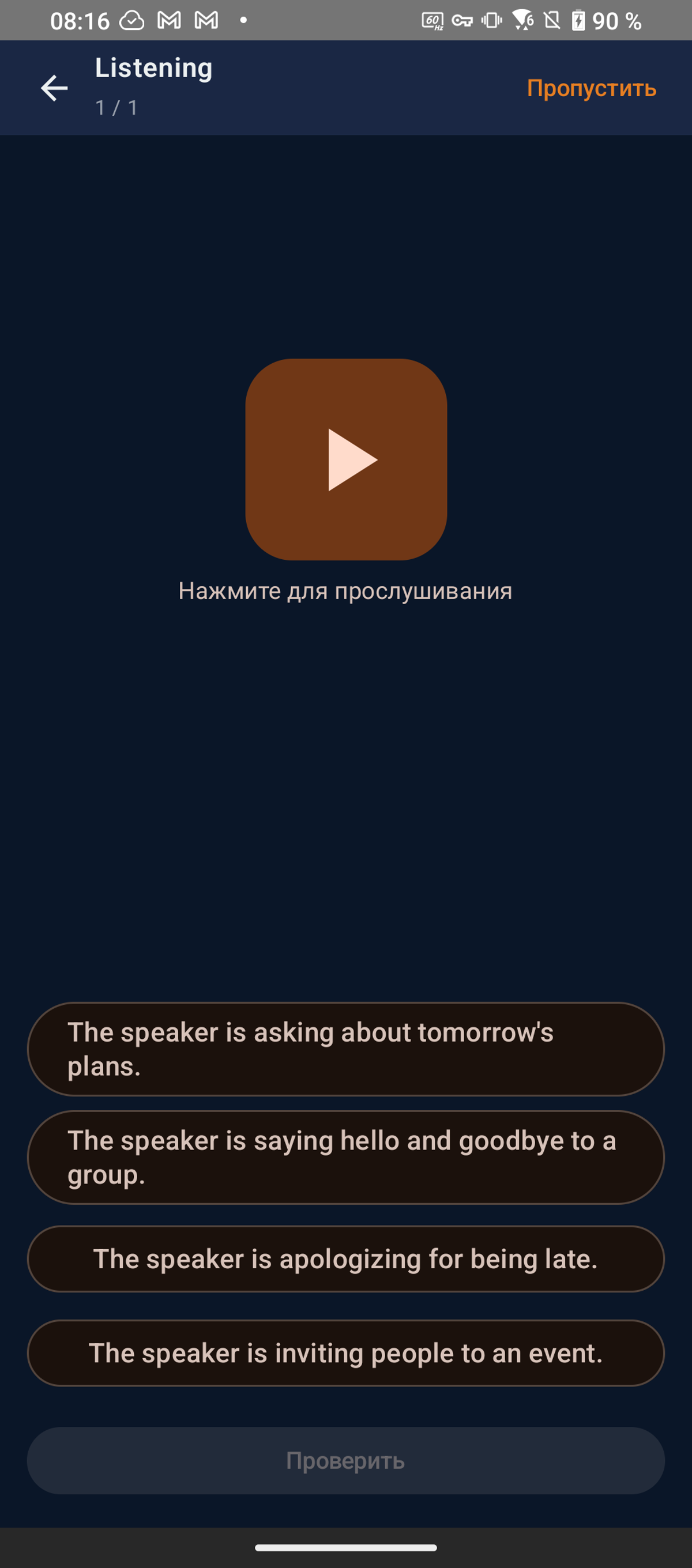
#49 Listening Available Now
CEFR A2–C1 listening comprehension
Hear it, understand it, prove it. Students listen to short audio passages and answer comprehension questions. Audio can be replayed, and questions target both gist and detail, training real-world listening strategies step by step.
Research basis: Built on process-oriented listening instruction: teaching learners how to listen, not just testing them (Field 2008; Vandergrift & Goh 2012).
#50 Dictation Available Now
CEFR A1–B2 listening spelling writing
Write exactly what you hear. A classic dictation reinvented: students listen to phrases and type them word for word. The exercise links sound to spelling and exposes precise gaps between what learners hear and what they think they hear.
Research basis: Dictation is a well-validated integrative measure of language proficiency, engaging listening, grammar and spelling simultaneously (Oller 1979).
#51 Audio Story Available Now
CEFR A2–B2 listening comprehension vocabulary
Follow the plot with your ears. Students listen to a short narrated story and answer questions about characters, events and sequence. Stories give listening a natural structure and emotional hook that isolated sentences cannot provide.
Research basis: Narrative structure (story grammar) supports comprehension and recall far better than disconnected input (Stein & Glenn 1979).
#52 Listening Diagnostic Available Now
CEFR A2–C1 listening phonological awareness
Find out exactly where listening breaks down. A two-phase diagnostic: first students show whether they can decode the sounds and words, then whether they understand the meaning. Separating the two reveals whether problems come from the ear or from the language.
Research basis: Distinguishing decoding from comprehension follows research on second-language listening and reading difficulties (Geva 2000; Field 2008).